Clear Titles, Big Investments: How Digitised Land Records Are Transforming Indian Real Estate
Digital transformation is not just a buzzword—it’s a pivotal development in India’s real estate scenario. Experts firmly believe that digitisation of land records stands as one of the most crucial factors in unlocking large-scale foreign investment (FDI) and ensuring long-term, sustainable growth for the sector.
The Momentum: Nearing 100% Digitisation
The Government of India has set an ambitious target: complete digitisation of land ownership records nationwide by December 2025—excluding only Ladakh and some parts of the Northeast. Currently, an impressive 99.8% of land records and 97.3% of cadastral maps have already been digitised. Additionally, nearly 90% of revenue courts are fully computerised, and all sub-registrar offices operate on digital systems now.
Why Experts Are Cheering Digitisation
1. Transparency and Reduced Disputes
Digitised records substantially lower fraud, disputes, and ambiguity over land ownership—a longstanding headache for developers, investors, and even ordinary citizens
2. Faster Land Acquisition & Better Investor Confidence
With clear titles, acquiring land—especially around tech corridors like Bengaluru or the Delhi–Mumbai Industrial Corridor—becomes quicker and smoother. This invites institutional and foreign investment into offices, logistics hubs, data centres, and more.
3. Access to Credit and Larger Parcels
Reliable land records ease access to financing and make it feasible to secure contiguous parcels—essential for large-scale infrastructure projects and township developments.
4. Efficiency in Residential and Commercial Projects
Early-stage investments in residential developments become more viable as title risks drop. Developers and funds are more likely to invest when ownership clarity exists.
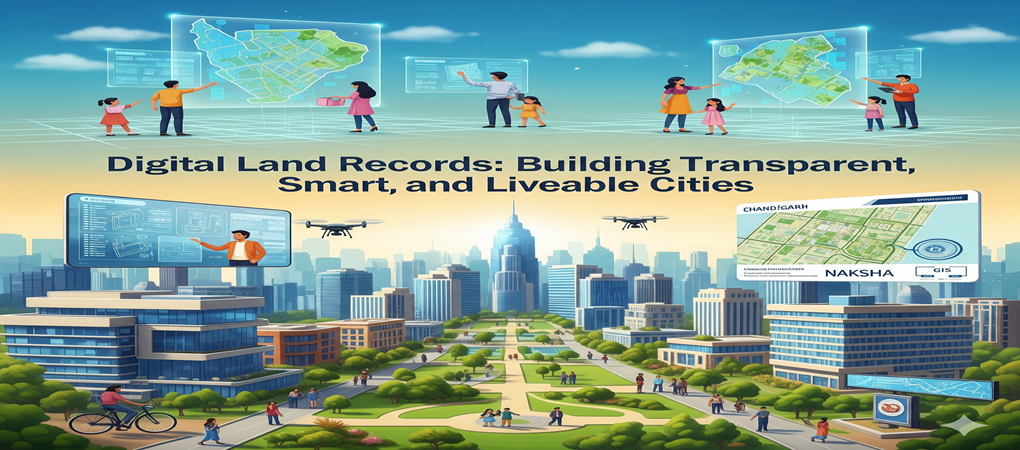
Integrating geospatial data (GIS, drone imagery, satellite mapping) allows smarter urban planning, disaster preparedness, and streamlined infrastructure rollouts. In Chandigarh, for instance, the Naksha pilot uses GIS, aerial surveys, and even blockchain to digitise land records and link them with property tax systems.
Spotlight: The Naksha Initiative in Chandigarh
Chandigarh has been chosen as a pilot city for the Naksha (National Geospatial Knowledge-based Land Survey) project under the Digital India Land Records Modernisation Programme (DILRMP).
Coverage spans 30.6 sq km, including Sectors 2–17 (excluding Sector 13) and five adjacent villages.
The project involves drone mapping, GIS integration, house-to-house surveys, and public engagement—to create a robust, centralised and tamper-proof system.
What These Reforms Mean for Foreign Investment
Despite global economic uncertainties, India’s realty sector is poised to attract a fresh wave of FDI. Already, $5.8 billion flowed into the sector in 2023–24, with digitisation expected to fuel further growth.
Foreign investors value clarity, security and procedural ease—all of which digitisation offers. Projects previously slowed by opaque land records, bureaucratic delays, and litigation can now proceed with confidence.
In a Nutshell
Advantage
Transparency & Reduced Fraud
Faster Transactions
Better Access to Finance
Smarter Urban Planning
Disaster Resilience
Impact
Enhanced investor trust
Speedier project launches
Larger developments, institutional funding
Efficient, inclusive infrastructure
Secure land entitlement despite calamities
India is racing ahead with land digitisation—and with it, the potential to become a global real estate destination that balances investment appeal with sustainability
What do you think?
Will digital land records revolutionise how we invest, develop, and plan our cities? Drop your insights in the comments below—let’s discuss!